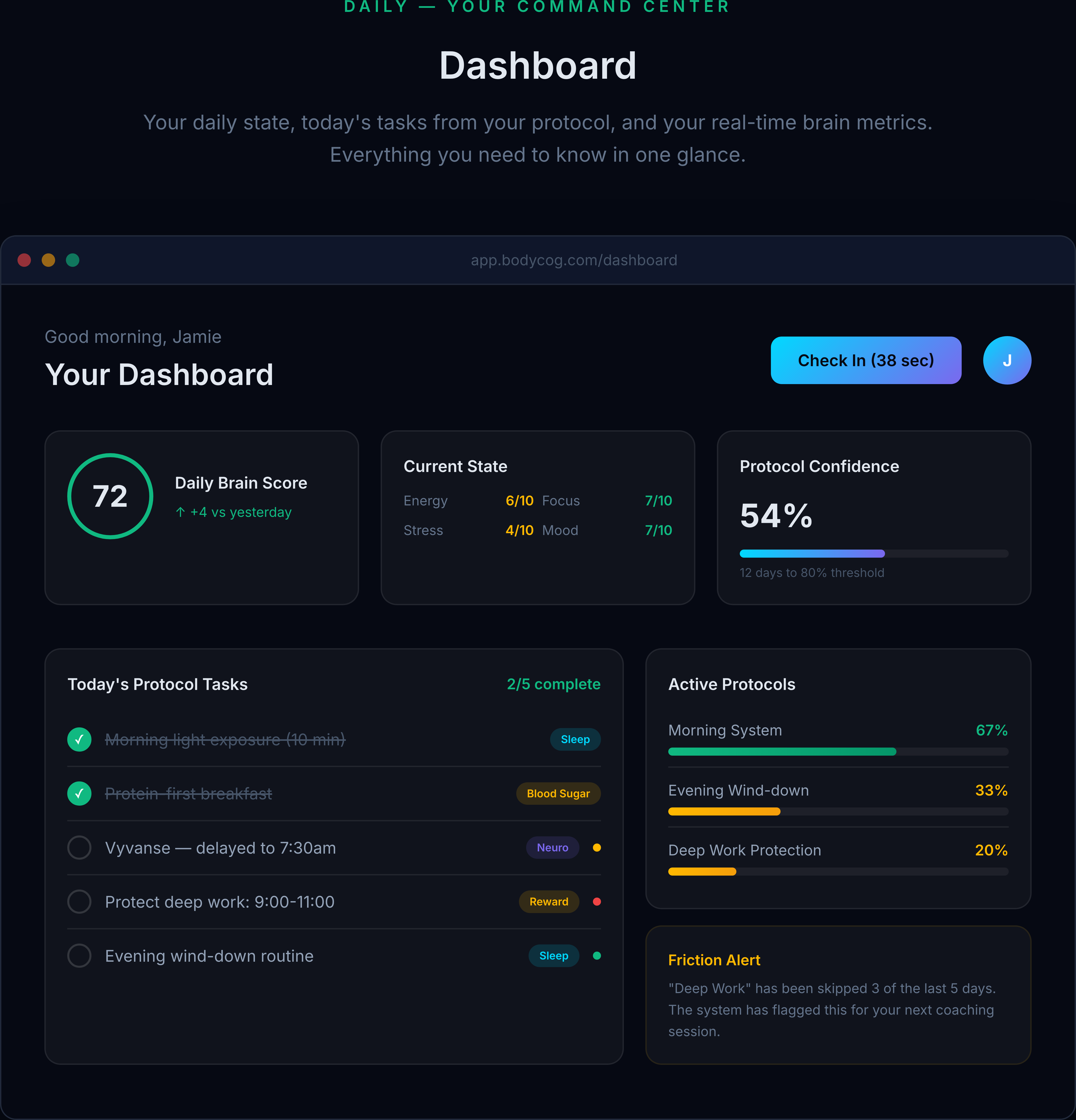
MyOS Brain Battery is a six-week program that teaches you how to build a personalised charging station for your brain's unique wiring. Minimal friction, maximum output. Designed around your goals and the demands of living life with a brain that was designed for more.
MyOS takes your existing data, finds your energy bottlenecks across behaviour, biology, and psychology, and creates a system for ADHD performance that eliminates complexity. So you can focus more of your energy on what really matters.
ADHD symptoms that hit hardest at work, distraction, overwhelm, task paralysis, stress, are not all due to "dopamine and executive dysfunction". Dopamine and executive problems are downstream of something more fundamental.
Energy.
Your ADHD brain requires 5-10x more energy to get the same tasks done as a neurotypical. The problem is no one's taught you how to build a system that charges your brain back up.
On your Brain Battery Call, you will discover how to build a brain battery system that works around your goals, lifestyle, and brain. Whether you choose to work with us or not, you will leave with a protocol designed specifically for you. Read on to discover how the system works.
See How MyOS Works ↓Maybe you run a business. Maybe you don't.
Either way, you operate at a level where your brain is the primary tool of your trade.
And right now, your brain is the bottleneck.
Some days you ship three weeks of work before lunch.
The next day you cannot bring yourself to open an email.
You can never seem to figure out why.
The gap between what you know you can do and what you actually produce is driving you slightly insane.
You've tried most of the obvious stuff. Creatine. Magnesium. A better mattress. A productivity app you used for four days before bailing in favour of another one you read about on a forum during a late-night rabbit hole. Maybe a sleep coach. Maybe an ADHD coach who gave you neurotypical productivity routines that felt like a sticker chart for adults.
Maybe you tried medication. It worked for a bit, and then it stopped. Some people told you it was bad for you. Others said it changed their life. All of it felt so confusing that you may have even tried different types of therapy. CBT. ACT. DBT.
Some of you reading this may have even gone "all the way" and packed your bags to Peru for a shamanistic ayahuasca retreat. When you got back, a functional medicine practitioner ran some blood work, suggested three more things, and sent you a bill that made your eyes bleed.
Some of it helped. For a bit. Until it didn't.
Right now, you're probably tired of trying to get a TikTok medical degree just to figure out which three things actually moved the needle for your specific brain.
The one thing you do know is that you need something tailor-made for you. Not something that works for everybody else.
The problem is that figuring out what moves the needle is harder than finding that needle, buried inside a haystack, at the bottom of whatever rabbit hole your brain has decided to go down this week.
You suspect there is a reason why your energy is so unpredictable. Why you struggle with the very tasks that would allow you to achieve what's truly meaningful to you. Why the task paralysis hits even when you know exactly what to do.
You are right. There is a fundamental, metabolic reason. One that has decades of research behind it.
But for some reason, it is not widely discussed by your favourite ADHD influencer. Or clearly explained by your psychiatrist or psychologist.
Without understanding this reason, you're relegated to something we call the trial-and-error graveyard.
Here is what most high-performers in your position have already spent by the time they find this page:
Total spend across two to three years: £5,000 to £25,000.
Net result: thousands spent, dozens of variables changed at once, and no clear idea what actually moved the needle.
Worse. The very brain power that would help you use your inherent pattern-matching strengths to make sense of all this requires fuel that your brain doesn't have.
Without knowing this, you think the problem is dopamine. You think the problem is executive function. You think you just need a better system.
This is not a personal failing. It is a structural problem. The rest of this page explains why.
Think about the last time you actually felt a bit better.
Maybe you started creatine that week. You bumped your magnesium. You went to bed an hour earlier because you finally got annoyed that your Whoop score was not consistently green.
You felt sharper. Less foggy in the afternoons. Maybe for a week. Maybe for three.
Now ask yourself the honest question.
Which one of those three things did it?
You do not know. You cannot possibly know. Nobody could. Not you. Not your therapist. Not the world's most preeminent psychiatrist specialising in ADHD.
Because it was never just three things.
That week you also had less client stress. You realised it at the time, but you didn't explicitly track it. Why would you? You haven't got time to track every variable in your life. No one does. Especially the people who actually end up figuring this out.
You also slept better on the Tuesday. You skipped the pub on Friday. Your partner was in a good mood. You happened to eat lunch on the same day for three days in a row, at the right time.
Every one of those moved a dial somewhere in your biology.
None of those dials were ever tracked.
The week after, when you crashed again, you had no idea which thing dropped out. You doubled down on the creatine. Or you added a fifth thing. Or you gave up, poured yourself another coffee, and added nothing.
This is the point where most people resign themselves to explaining all of this with a lack of discipline, willpower, or motivation.
This is the loop every high-performer in the graveyard is stuck in.
You change several things at once, because real life does not let you change one thing at a time. The result is a blur. The experiment never gets a second chance, because there is no control condition. The next new thing lands on top of the old confusion.
It is not a willpower problem. It is not a discipline problem. It is a measurement problem.
And you cannot think your way out of a measurement problem with the same brain that cannot remember this morning's to-do list. You cannot think your way out of it without knowing which data actually makes sense to track, versus which data will send you insane trying to keep on top of.
You may have heard we can hold seven items in our head at once.
That number is a myth.
The classic "magic number seven" only applies when you can chunk and rehearse.
Your actual focus of attention holds about four things at once.
That is the hard limit.
Yours. Mine. Everyone's.
For ADHD brains, that four-slot capacity is even more fragile. Distractions and competing demands burn through it faster, leaving almost nothing for executive control.
Now count what is actually live in your life right now that is touching your brain on any given day:
At any given time, the amount of inputs your brain is trying to manage is overwhelming when you actually stop to think about it.
Every one of them is talking to the others.
Your mind-body contains almost infinite complexity. Somewhere in that system are the three levers that would change everything, if you just knew where to look.
You know you can solve puzzles like this. Your brain is a pattern-matching machine. You've done things like this before.
But you are trying to solve a 100-plus-variable puzzle with a four-slot focus of attention. And those four slots are already half-full with running your business or doing your job.
Worse. It's impossible to keep track of which variables are remaining consistent versus which variables are changing without you realising.
There is no amount of journalling that fixes this. No spreadsheet either. Especially when the thing you are trying to fix, your uniquely wired brain, is the thing you would need to build the system in the first place.
You might think, fine. If my brain cannot hold all this, I will pay someone whose brain can.
You have probably already tried that. Here is what tends to happen across most of the clients we've worked with.
Each professional sees their own column. Each one does their job well within their remit.
The problem is that your actual root cause almost always lives in the gaps between columns. And nobody is paid, trained, or given enough time to stand in the middle and join the dots.
To truly understand all of this complexity and find those secret levers that would unlock everything, you would need a specialist living with you 24/7. Taking in all your wearable and biomarker data alongside subjective reports of how you're feeling each day. Tracking all of this on a long enough time horizon to find out what really moves the needle for you.
And no, ChatGPT cannot do it either. It will happily write you a plan that sounds confident. It has no persistent memory of you. It sounds like it does, but it doesn't. You notice this when it forgets small details that would derail an entire plan of yours. It cannot run experiments on what works uniquely for you and your goals. It is pattern-matching text, not modelling your biology, psychology, behaviour, and lifestyle.
What you really need is one of two things:
Option 1 does not exist.
That's why we built MyOS.
Three layers. In this order. You cannot skip one and fix the next.
This is your metabolic budget. ATP production. Mitochondria. Sleep architecture. Nutrition. Movement. If your hardware is depleted, you literally cannot afford the metabolic cost of focus, planning, or emotional regulation. The brain forces the prefrontal cortex offline and you default to survival mode.
We fix the battery first.
This is your resource manager. Dopamine, serotonin, norepinephrine. Signal-to-noise ratio. Once the hardware has a consistent power supply, we calibrate how the operating system allocates that energy so you can hear the signal over the noise.
We calibrate the OS second.
These are the habits, environments, and narratives you built while your brain was broken. Most of your "ADHD traits" are not traits at all. They are adaptive coping mechanisms for a brain running on empty. They were built for broken hardware. Once the power supply is online and the OS is calibrated, we rebuild the system around a turbocharged brain.
We rebuild the software third.
Most ADHD systems start at Tier 3. They tell you to reframe your thinking. Build better habits. Use a planner. But reframing requires energy your Substrate does not have. You are trying to run a data centre on a phone battery.
Others stop at Tier 2. Medication restores the signal. But it does not rebuild the system of habits and environments that formed during years of chaos.
We fix the tiers in causal order: Hardware first. OS second. Software third.
Doing them in the wrong order is exactly why every other system fails.
Ask me how I know.
My name is Jamie. I'm the founder of BodyCog and the person who built MyOS.
I'm also a qualified psychotherapist, personal trainer, nutritionist, and hypnotherapist.
I spent five years as a senior account executive at a hypergrowth enterprise AI company. My ADHD brain allowed me to remain the highest-billing rep in the fastest-growing team for 3 years, when average churn was 9 months.
To do that, I was unwittingly burning all of my brain's energy doing things it was not designed to do.
At some point, it stopped working. I know exactly what it feels like when the brain you rely on for high performance suddenly stops working.
I spent most of the last decade in exactly the graveyard I described above:
Several things actually worked:
Despite all of that effort, things still weren't quite clicking.
I went to every specialist you can think of. Psychologists. Endocrinologists. Psychiatrists. Functional doctors. Sports doctors.
I made a little bit of progress with each of them. None of them joined the dots. Not because they were bad at their jobs. Not because Big Pharma is evil. Because the problem is way bigger than any one specialty can handle.
The part that broke me was this:
I would fix one thing. Then something else would go wrong. Then something else would go wrong that I did not realise was connected, and a new problem would pop up somewhere I was not looking.
I would spend two months figuring out why. Or I would discover some new insight that would change everything, only to find it in my own notes from six months earlier. Problems I had already solved felt new because I just could not hold all the solutions in my head long enough to remember I had solved them.
Whack-a-mole. With my own biology. In slow motion. While I watched my work performance decline.
Eventually I realised the only way out was to build something outside my head. A system that could track what I changed, what happened after, how the pieces connected, and keep a living record of all of it in a way a knackered brain could actually make sense of.
That system became the first version of MyOS.
A few people asked if they could use it. Friends started asking what I was doing, what I was taking, and why I looked different.
I told them about the system I built. An AI-powered research pipeline that connected every level, from genetics all the way up to behaviour, with everything in between. A few of them asked if that same system would work for them. And if I could coach them to use it.
When they got results, more people asked. I started seeing the same patterns across different people. Same graveyard. Same confusion. Same wrong-order fixing.
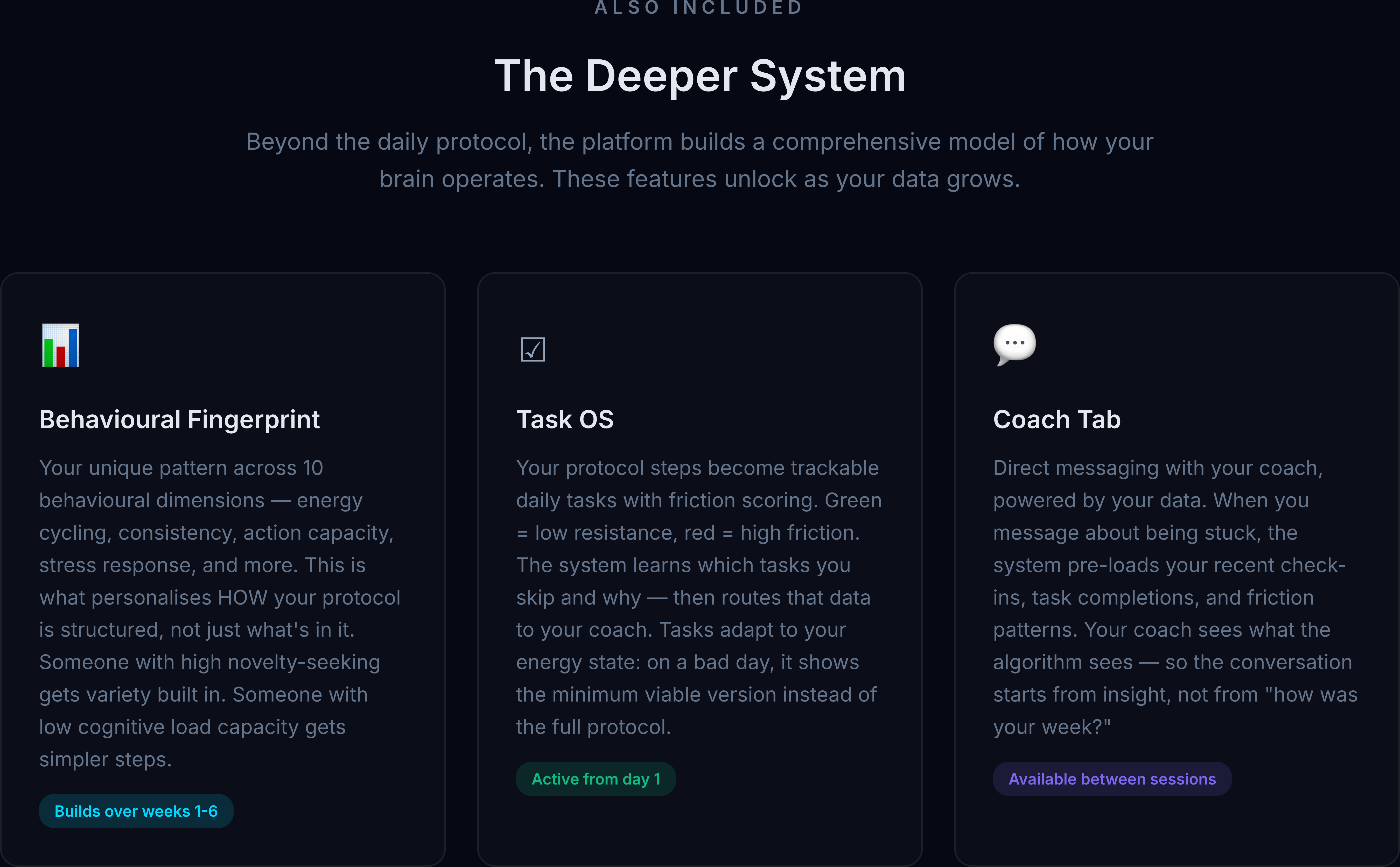
So I started building the system out so clients could use it themselves between sessions. That way we could focus our session time on the things no AI can ever help with: how to manage social situations when you're doing an elimination diet. How to explain what you're doing to your friends and family. Why the system has to be built by someone who's been through the challenges that led to its necessity.
50+ 1:1 clients later, MyOS is the tool I wish had existed when I was stuck. That is what I am giving you access to as part of the MyOS Brain Battery Founders' Programme.
The MyOS Brain Battery six-week programme is structured. It has to be. You do not have time for a vague "let us see what happens" coaching relationship, and we do not run those anyway. Six weeks. 1:1. With the MyOS system running underneath, tracking everything.
The tiers are fixed in order. Hardware first. OS second. Software third. You cannot calibrate an OS on a computer that has no power supply. You cannot rebuild software on top of an OS that is still producing errors.
Fix Your Energy Supply
We find exactly where your brain's energy production is breaking and fix it.
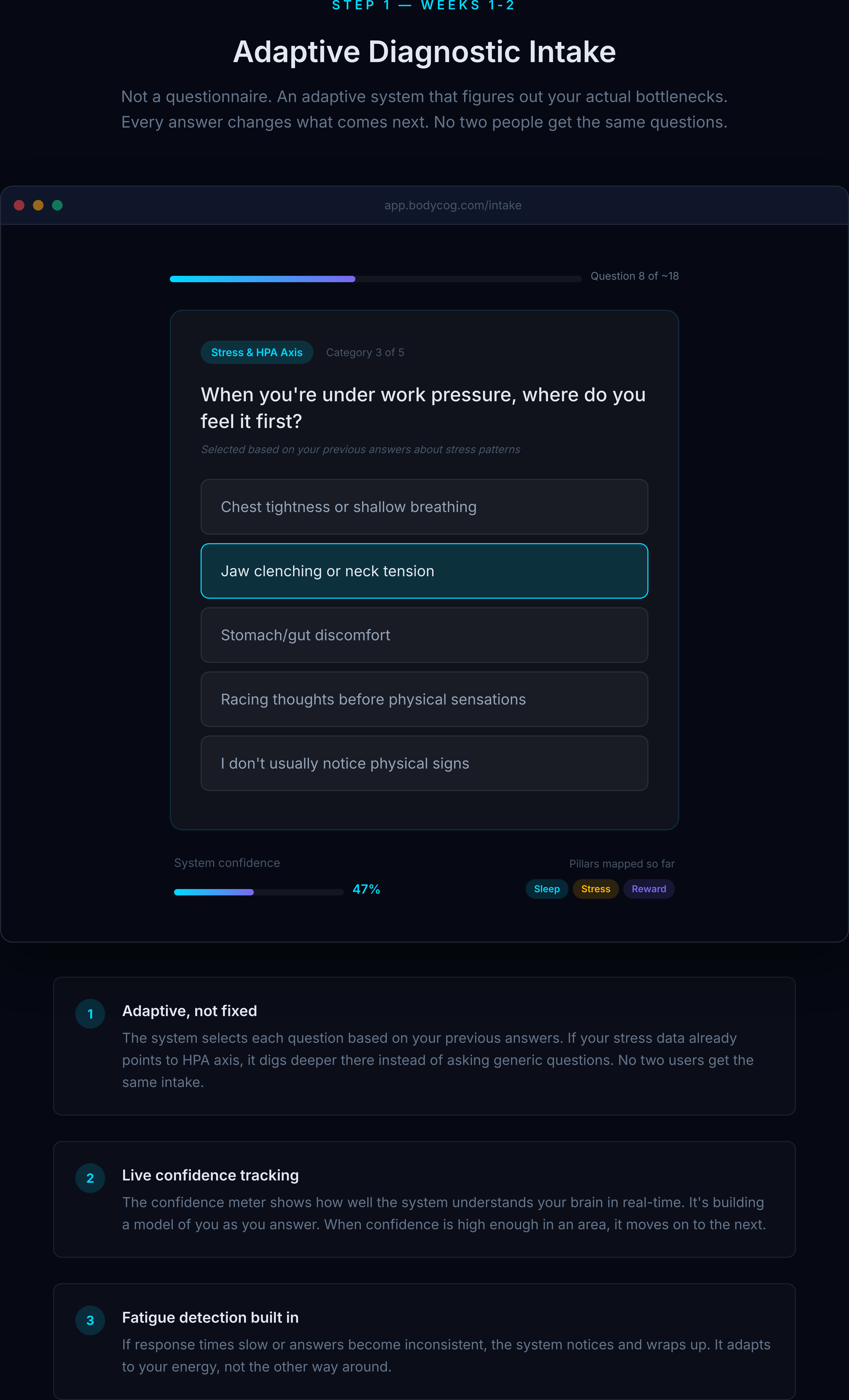
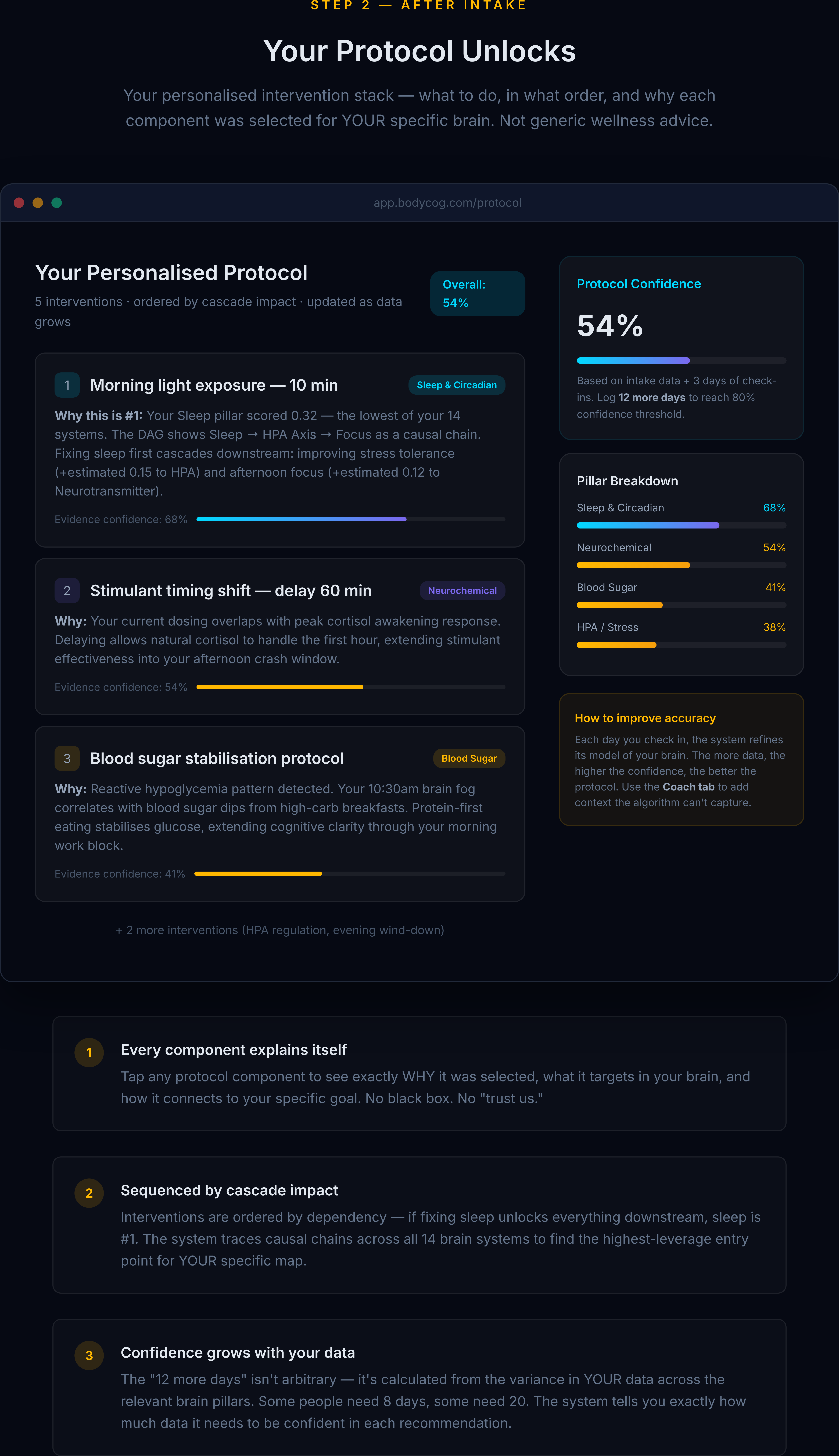
How it works: You send health data before call one. We map your architecture and build your protocol from it.
Calibrate The Operating System
With energy stable, we fix the resource manager that decides what gets your attention.
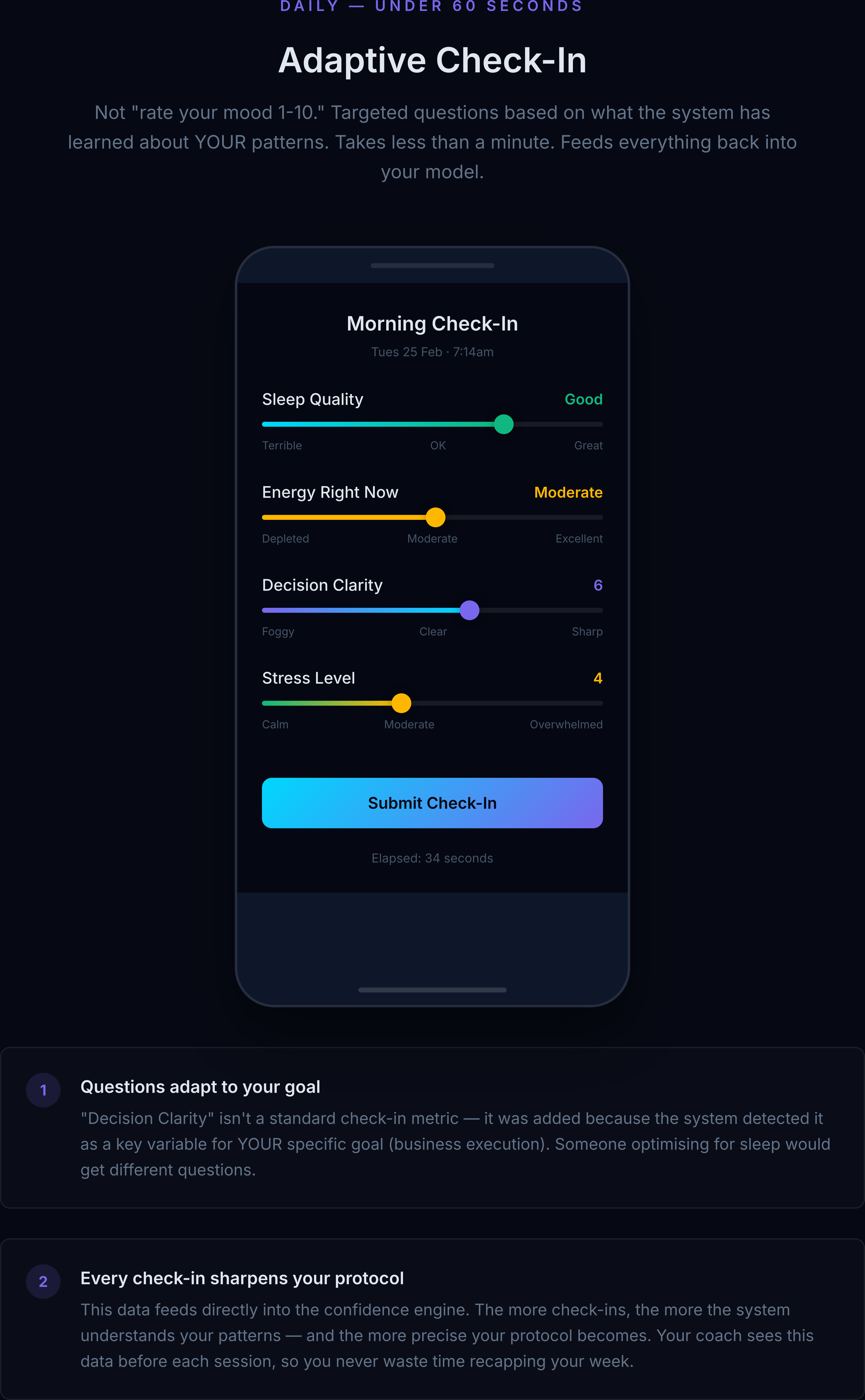
How it works: We use your daily check-in data to spot crash patterns and build practical structures around your real life.
Rebuild Your Habits On Working Hardware
Your brain works now. We restructure your life to match.
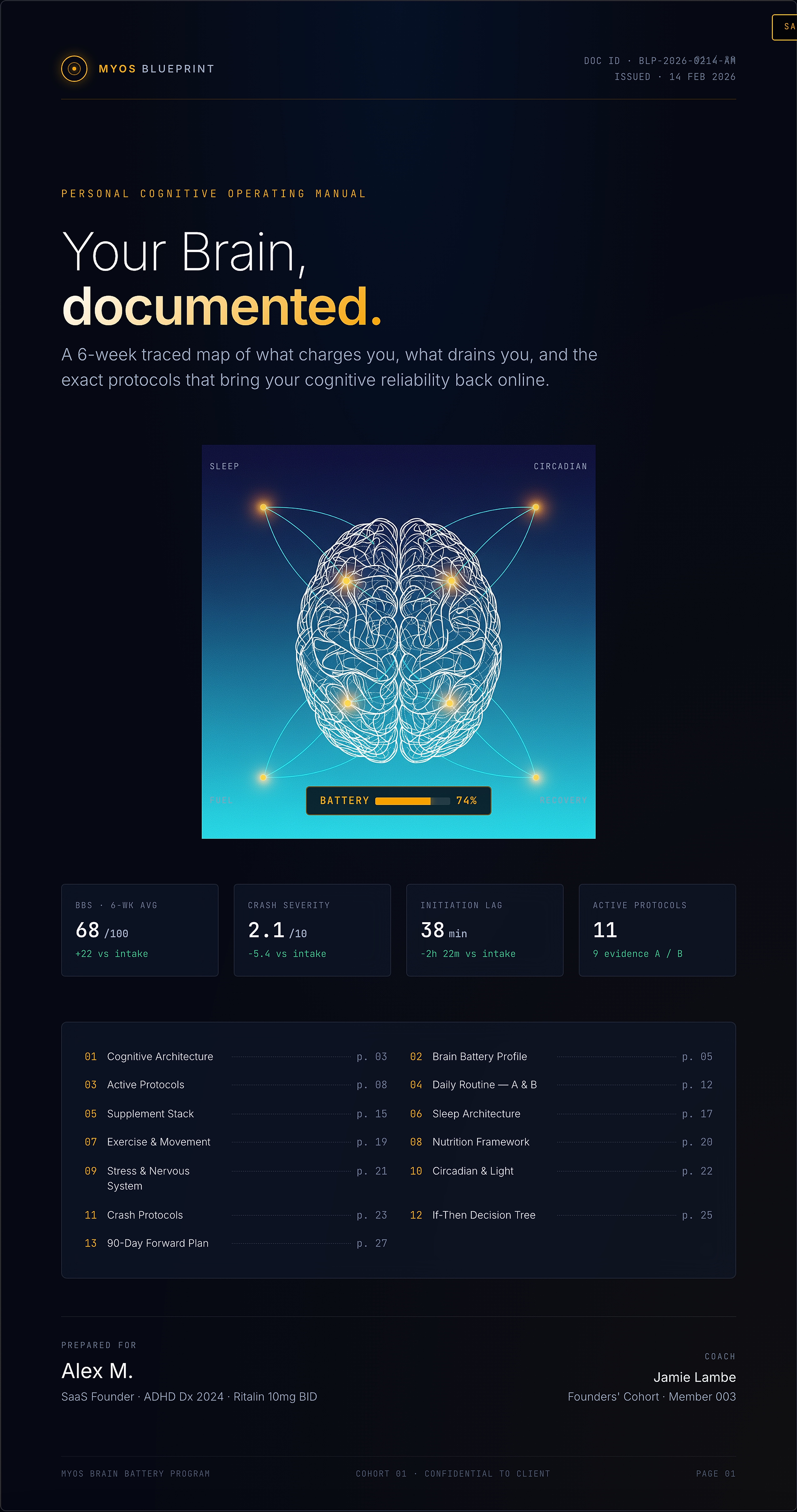
How it works: We review six weeks of data, lock in what worked, and hand you a documented operating manual.
Time commitment: Around 65 minutes a week of structured time, plus under a minute a day on check-ins. The protocol itself lives inside your existing routine. It is not a second job.
Founders' Cohort. 5 places only.
Six weeks of 1:1 coaching, the app, the Blueprint, and lifetime access.
Book Your Free Brain Battery CallHere is the honest reason the price is this low for the first five people.
We've previously run this system with 50+ people. The MyOS app is currently at version 2. Version 3 is launching in a few months.
We need five serious people who are committed to running through the full programme, with real data, to tell me what works and what does not.
The feedback you give me during the six-week programme, including features you want built, UX improvements you wish existed, and anything else you flag, will be used to make version 3 of the app even better. You will get lifetime access to it.
You get a lower price and founding-member access. I get real data from real people to harden the system before it opens to the full market.
Once the five places are filled, the price goes to £597.
Do the work: show up to the calls, do the check-ins, run the protocols. If you do not see a meaningful improvement in the ninety days from the start of the programme, I will refund you in full.
I can offer that because the order is not an opinion. It is how the brain actually works. Fifty-plus clients, built on a decade of me doing this to myself first. But if it does not click for you, you are not stuck paying for something that is not working.
Once they are filled, the price goes to £597.
The question is not whether you need this. It is whether you do something about it before the places are gone.
Book Your Free Brain Battery Call