5 Founder Places

Find out why your brain is fried.

Build an ADHD Operating Loop that powers your brain to perform the way you know it can.

On Tuesday you can rewrite a business plan before your first coffee. On Wednesday, you can't open a single email. Same brain - different state, different outcomes. The Brain Battery Recharge is a six-week 1-2-1 coaching and Personalised ADHD OS install. We map where your execution breaks, externalise the cognitive functions that cause it - like memory, context and sequencing - and install a Daily Operating Loop that survives contact with your real life, not the one that lives in that beautiful, fantastic head of yours.

5 Founder Places £297 £597

“Fried” is not one problem

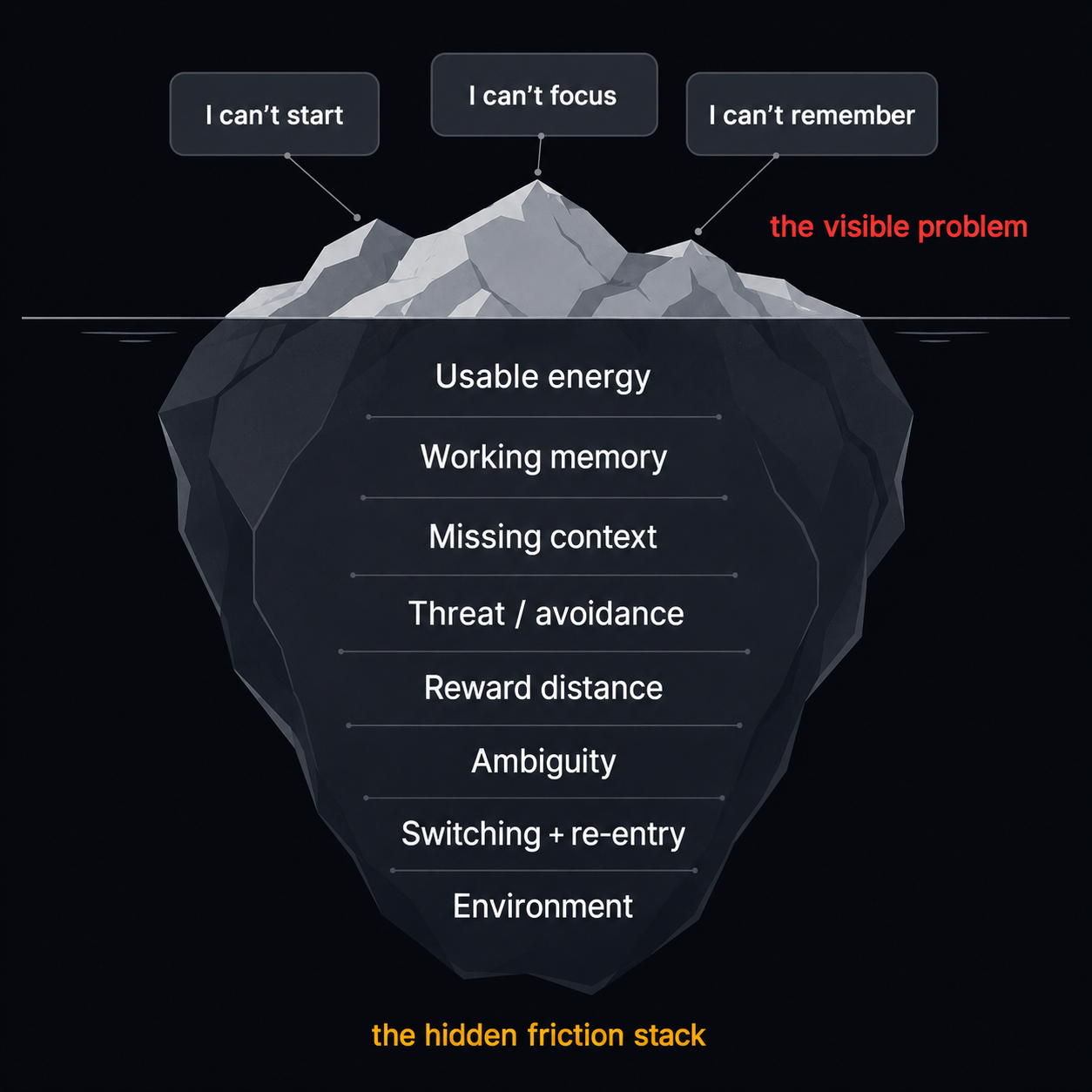
ADHD problems are usually just the tip of the iceberg.

“I can’t start,” “I can’t focus,” “I keep forgetting” and “my routine collapsed” are surface level descriptions. Each one can be produced by different constraints, for different people - and each constraint needs a different kind of support. Without a system that identifies which constraints are active for you, your specific wiring, your specific tasks and your specific life...  You end up with cookie cutter "systems" and "hacks" which never evolve into something reliable that runs across your life

Same surface problem. Different constraint. Different support requirement.

The ADHD execution iceberg: visible problems above the waterline, the hidden friction stack below.

Read this first

Who this is for

For ADHD founders, operators and knowledge workers whose execution stops being reliable under changing state, heavy context load, open loops and tool sprawl (hello my friends Chad Gipidi and a french lad called Claude). If a wrecked week takes your output with it - and you’re sick of calling that laziness or lack of discipline - read on.

This is for you if…
  • You’re a founder, operator, consultant, creator, agency owner, coach or knowledge worker.
  • You have ADHD, suspect you do, or already recognise the execution patterns.
  • You want something that doesn’t lean on the parts that fail you - initiation, prioritisation, follow-through, recovery.
  • You’ve tried tools that solved part of the problem, or became another system to maintain. AI is in this category.
  • You want a real operating loop that lasts and adapts - not another theory to collect.
This is not for you if…
  • You want a diagnosis, treatment plan, medical protocol or a replacement for clinical care.
  • You’re in mental health crisis and need urgent professional support.
  • You want magic automation that runs your life without you in it.
  • You won’t show up to the calls or do the bare minimum friction check-ins.
  • You want someone to pretend a complex system has one universal root cause or fix.

The capability gap

You know you’re smart. People rarely question that.

What makes no sense is why the same brain that can solve a genuinely hard problem can stall on an email, forget lunch, lose a decision after one interruption or need heroic effort to restart a simple task that you know you know... just not right now.

The problem is not intelligence. It is reliable output.

1
You can perform at an absurdly high level - until you can't. And there are no warning signs before you've driven off the cliff.You know capacity changes with sleep, stress, recovery, context, workload and the type of work in front of you... but the exact pattern is unclear
2
You know what needs doing, but starting, switching, finishing or restarting fails unpredictablyYou know there *must* be a system to figure this out, but planners, apps and AI repeatedly lead back to the same problems
3
Your tools help - and then become another system to remember, feed and maintain.AI can amplify the problem by generating more inputs, options, plans and open loops than your operating system can absorb. 
4
You keep solving pieces of the problem without ever writing them back to a stable mapPart of the problem is figuring out what the problem actually is, but solutions are useless unless they're written back to a stable place you can trust.

Why previous solutions only worked for a while

Most "solutions" and "systems" solve one easy, visible part of the iceberg - and present the remaining problems back to you on a silver platter

The tools are not necessarily bad. The systems can work. The problem is they are not usually built with the cognitive neuroscience of ADHD in mind. They are then aimed at a category - planning, memory, habits, energy or automation - before anyone has worked out which cognitive function is actually failing.

What you tried What it can genuinely help with What it still asks you to do How the problem mutates
Planner or task app Stores tasks and makes commitments visible. Choose the right task, understand it, load the context, match it to your state and start. You now have a complete list of things you still cannot reliably do.
Second brain or notes system Captures ideas, references and decisions. Remember where it lives, remember to use it, create the note classification system and translate it back into action. The memory problem becomes a retrieval, structure and maintenance problem.
Habit routine Reduces decisions when state and context are stable. Run the same sequence on bad days, long enough to stick, recover after a miss and adapt when life changes. One missed day becomes a collapsed system and another shame loop.
AI assistant or automation Generates options, drafts, plans, summaries and workflows quickly. Supply the right context (entire field of AI engineering), judge output, choose what matters and manage more generated possibilities. The output problem becomes an input, decision and orchestration problem.
Tracking, wearables or supplements Can surface useful state clues or support parts of your health routine. Interpret the signal, connect it to work and remember what changed after an intervention. More variables appear, but the daily decision still lands back on you.
01 · Surface“I forget things.”You assume the problem is storage.
02 · Proxy fixBuild a second brain.Now everything is captured.
03 · Hidden workRemember to use it.Retrieve the right context at the right moment.
04 · MutationMaintain the system.Structure, tags, prompts, automations and cleanup.
05 · Same constraintThe missing function never moved.You still need point-of-action retrieval and an easy re-entry path.

Every fix above targets a surface level symptom. None of them target what's underneath.

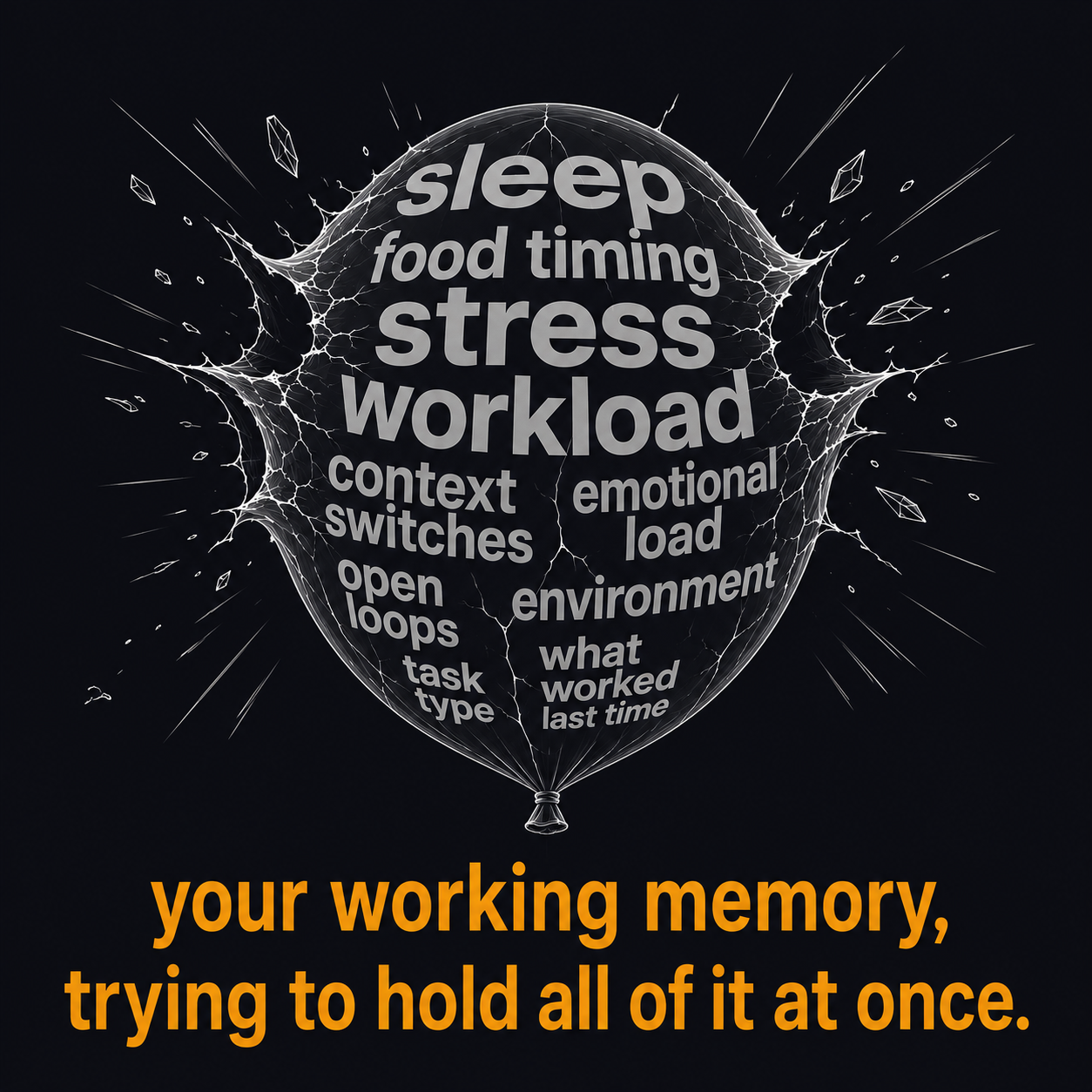
Working memory drawn as an over-full balloon about to burst under sleep, food timing, stress, workload, context switches, emotional load, open loops, environment, task type and what worked last time.

The cruel part

You cannot identify the problem, and fix the system with the parts that don't work

When your brain is fried, it is rarely one variable. Yet you are expected to notice all of them, interpret them correctly, remember your previous experiments and still choose the right next action.

You can have all the pieces and still not see the map. You can even solve the problem, forget how you solved it and start from zero the next time the same pattern appears in a slightly different outfit.

That is why the system has to sit partly outside your head.

From break to build

Every constraint is just a solution waiting to be installed.

A “fried brain” isn’t one vague failure - it’s a stack of specific, nameable constraints. Name the constraints and it stops being a character flaw. It's no longer part of you.

It becomes a target with a matching support.

Constraint

Usable energy runs out mid-task.

The support

A Brain Battery read that routes work to the state you’re actually in.

Constraint

Working memory drops the thread.

The support

Context saved at the point of action, instead of held in your head.

Constraint

Re-entry starts from zero after every interruption.

The support

A one-click restart that reloads the last decision and next move.

Mapping the complexity

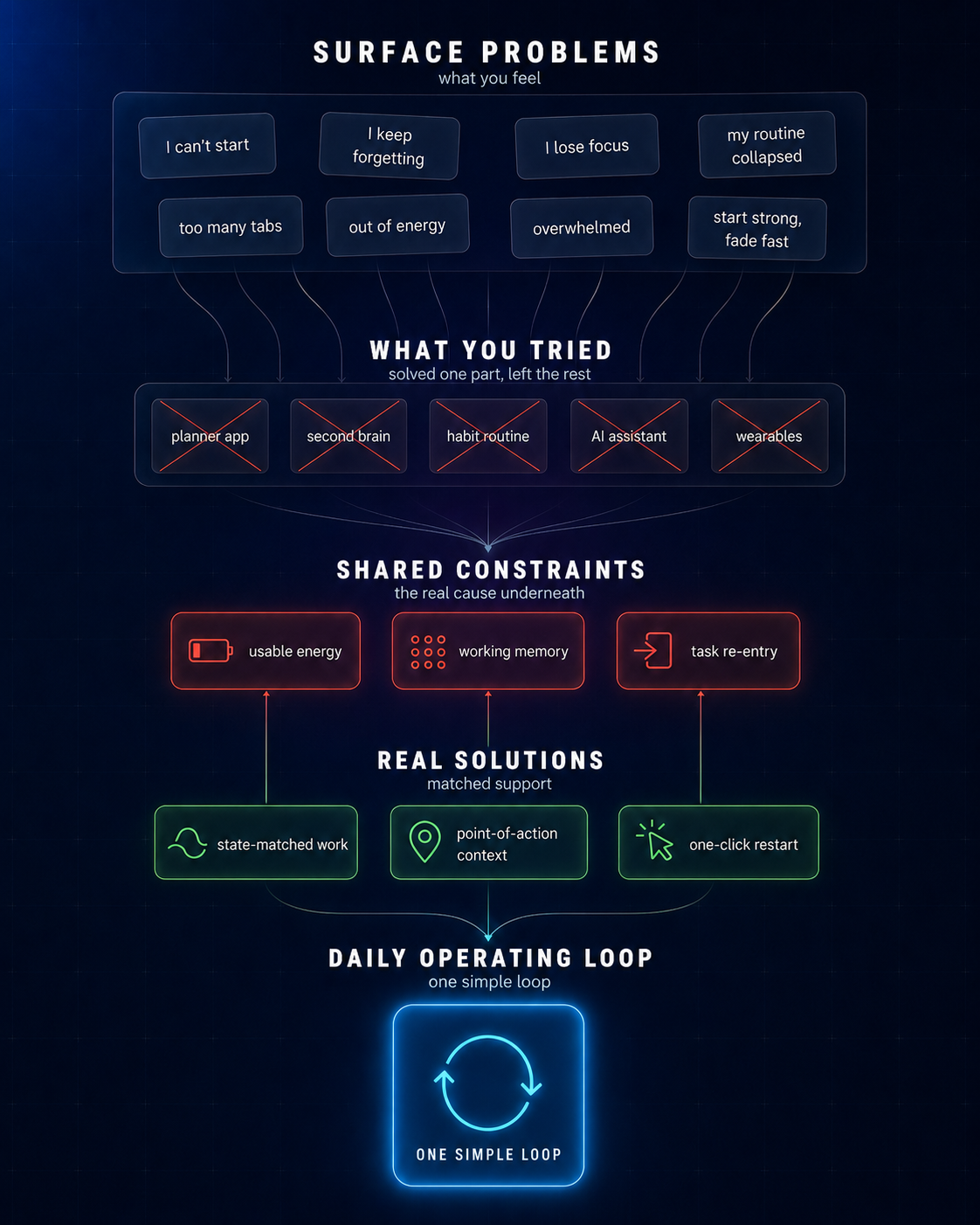
We map every surface problem, collapse the complexity, then hand back one simple daily protocol.

Behind every “I can’t start” sits a web of problems, constraints, failed fixes and requirements. We map the whole thing once - so you never have to hold it in your head - then collapse it down to the few moves that actually change your day.

01 · Map

Surface every problem

Lay out the full picture - surface problems, the constraints underneath them, and the fixes that only ever half-worked.

02 · Collapse

Collapse the complexity

Route that map down to the small set of active constraints and the specific supports that actually remove them.

03 · Protocol

Run a simple daily protocol

What’s left is a short, repeatable loop you can run on a low-battery day - not another system to maintain.

A vertical funnel: scattered surface problems collapse into a row of crossed-out failed solutions, which trace down to three shared constraints (usable energy, working memory, task re-entry), each mapped to a matched real solution (state-matched work, point-of-action context, one-click restart), all converging into one simple daily operating loop.

The four-part operating system

Recharge your brain. Map your wiring. Make action easier. Remember what works.

The programme does not hand you another generic system. We build a loop around your state, cognitive architecture, work and life.

01

Brain Battery

What does your brain need?

Not one vague energy score. A practical view of which kinds of work your brain can realistically run in the state you are actually in.

  • Deep reasoning vs admin
  • Decisions vs execution
  • Creative work vs social load
  • Push, protect, simplify or recover
02

Wiring Map

Where does execution break?

We map how a piece of work moves from goal to completion, then identify the phase and function that keep dropping out.

  • Context, memory and salience
  • Prioritisation and sequencing
  • Initiation, continuation and switching
  • Completion, closeout and re-entry
03

NeuroNudges

What makes action easier?

We design small changes to the cue, context, sequence, environment, reward or first move around the exact point of friction.

  • Reduce ambiguity and effort
  • Restore missing context
  • Add salience or nearer feedback
  • Create low-energy and restart paths
04

MyOS

How to put all this together?

MyOS holds the context, tracks what happened and helps personalise the next loop so you do not need to reconstruct the system every morning.

  • State, task and break point
  • What was tried
  • What moved and what did not
  • What to surface next time

Brain Battery tells us what your brain needs.  Your Wiring Map shows us how it works. NeuroNudges make the next move easier. MyOS turns the result into a flywheel.

How it works

From raw inputs to one loop you actually run.

Each step feeds the next. These screens use MyOS v2 UX assets and runtime/source-backed visual projections.

Step 01

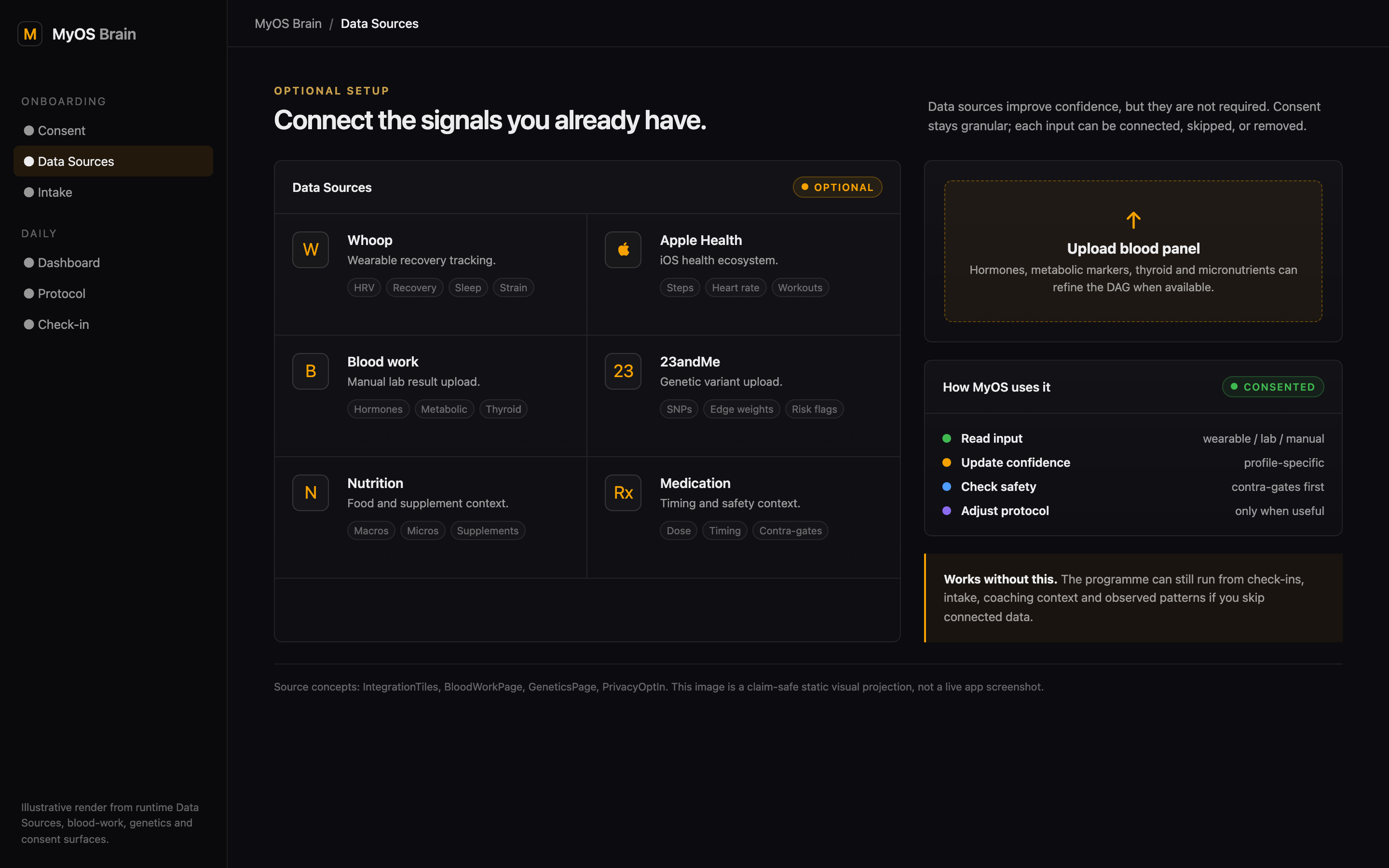
Connect and make sense of your data

Connect wearables like Whoop, blood work, nutrition data, supplements, medication and even genetic data from 23andMe. All of it can be used for a higher-resolution, higher-confidence analysis by MyOS. Our security is robust and you can read our policy here - but if you'd rather not, or if you don't have this type of data, this step is 100% optional and the system still works without it.

Data source setup in MyOS showing optional wearable, blood-work, nutrition, medication and genetics inputs.
Step 02

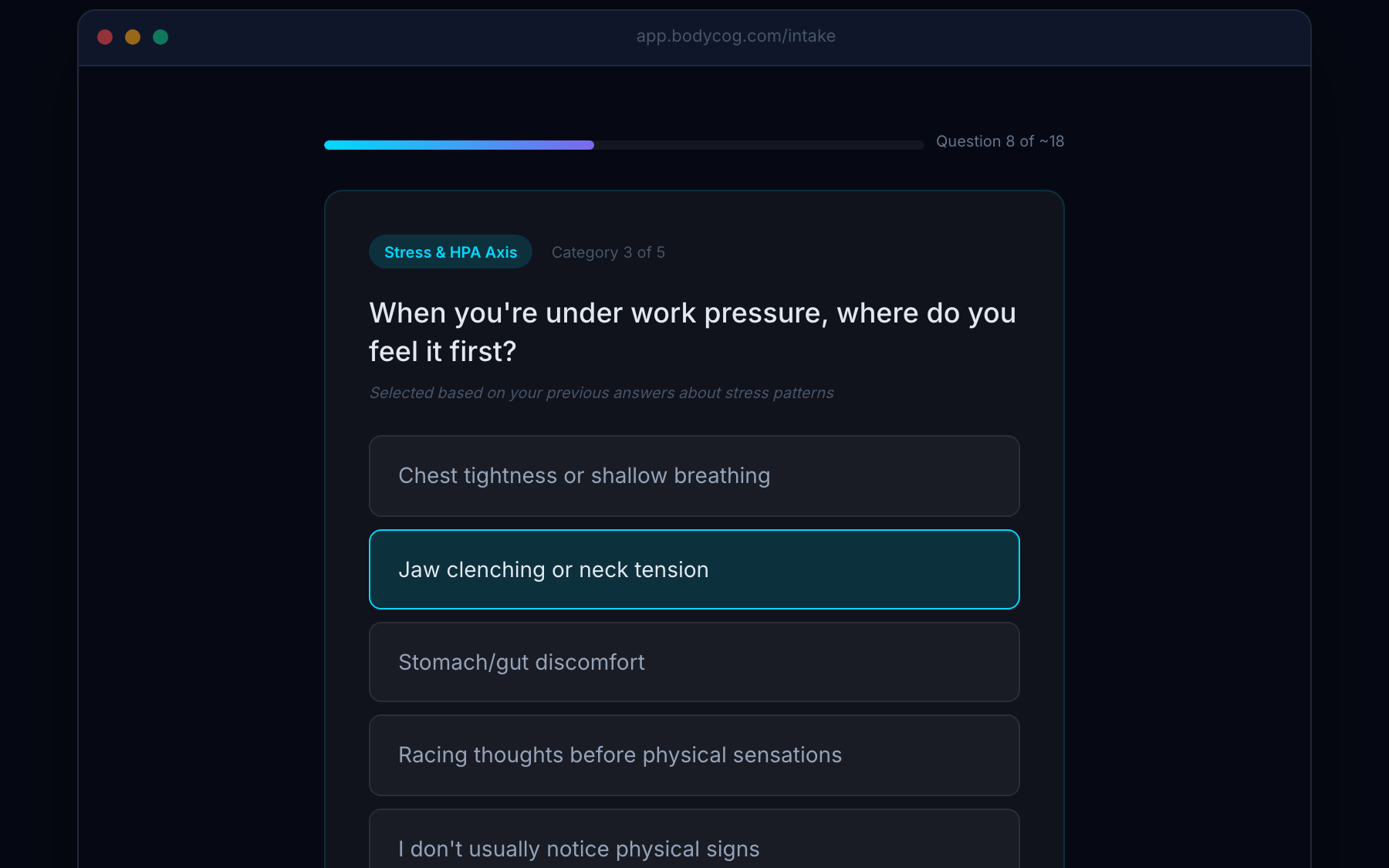
Dynamic intake

Continuous inputs flow in - wearables, genetics, nutrition, sleep, workload and how your real week actually goes. No one-off questionnaire frozen in time.

Dynamic intake quiz screen with Brain Battery forming from answers.
Step 03

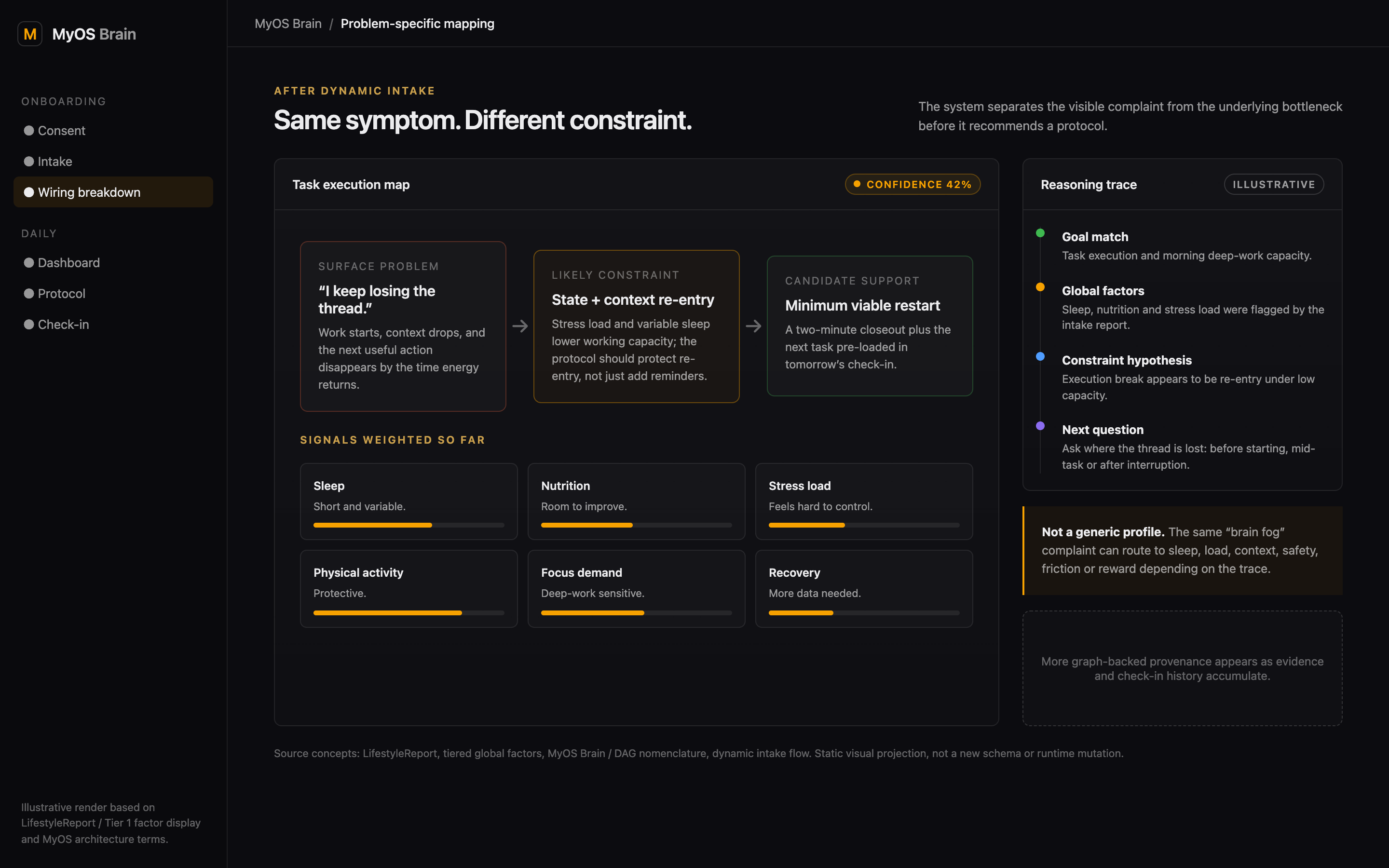
Problem-specific mapping

We map where execution breaks against your specific wiring - not a generic profile. The same surface problem gets traced to the constraint actually causing it.

Problem-specific wiring breakdown showing visible problem, likely constraint and candidate support.
Step 04

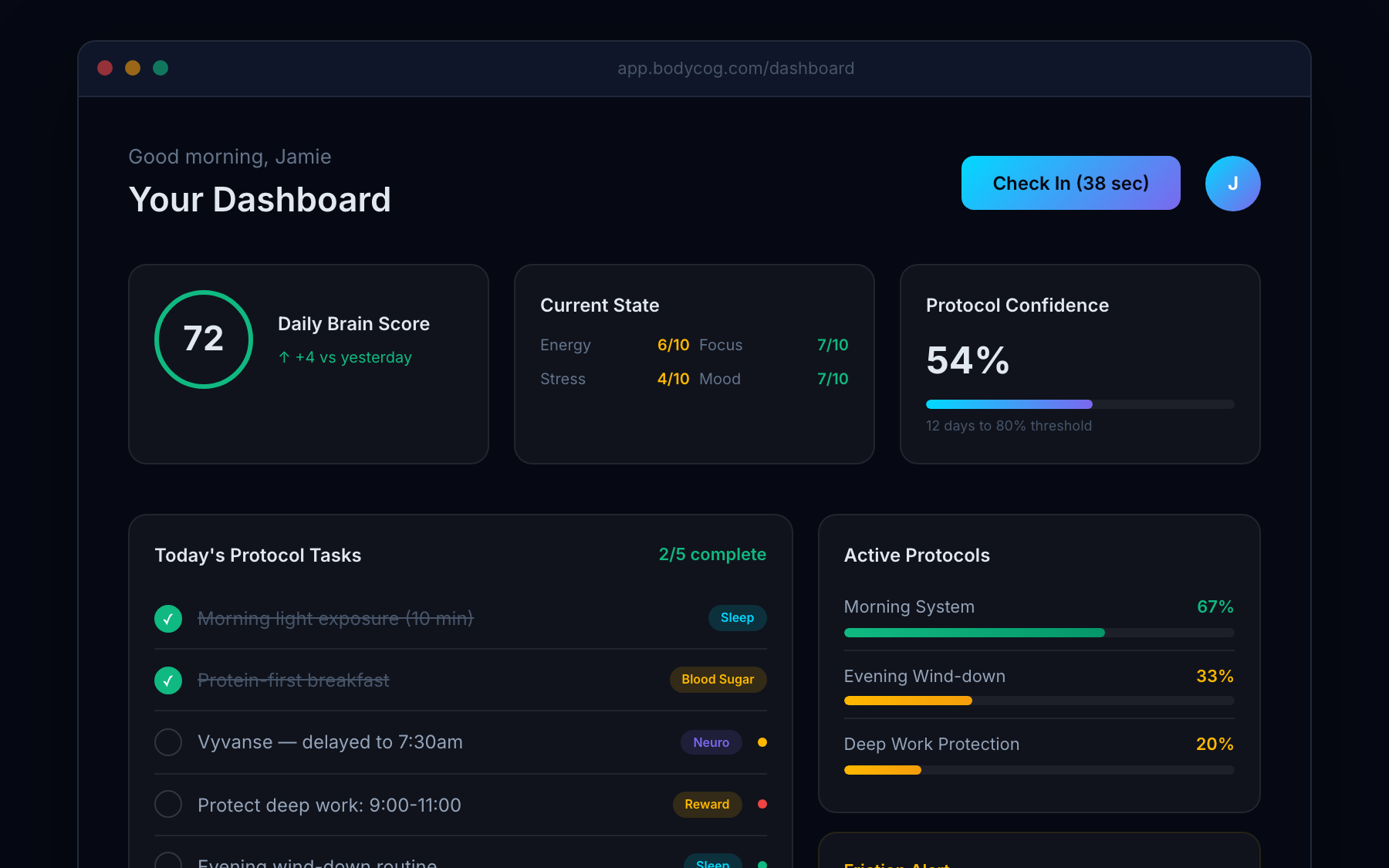
Brain Battery score

A live read of what your brain can run right now, so work gets routed to the state you actually have instead of the one the plan assumed.

Brain Battery dashboard showing today's capacity and protocol confidence.
Step 05

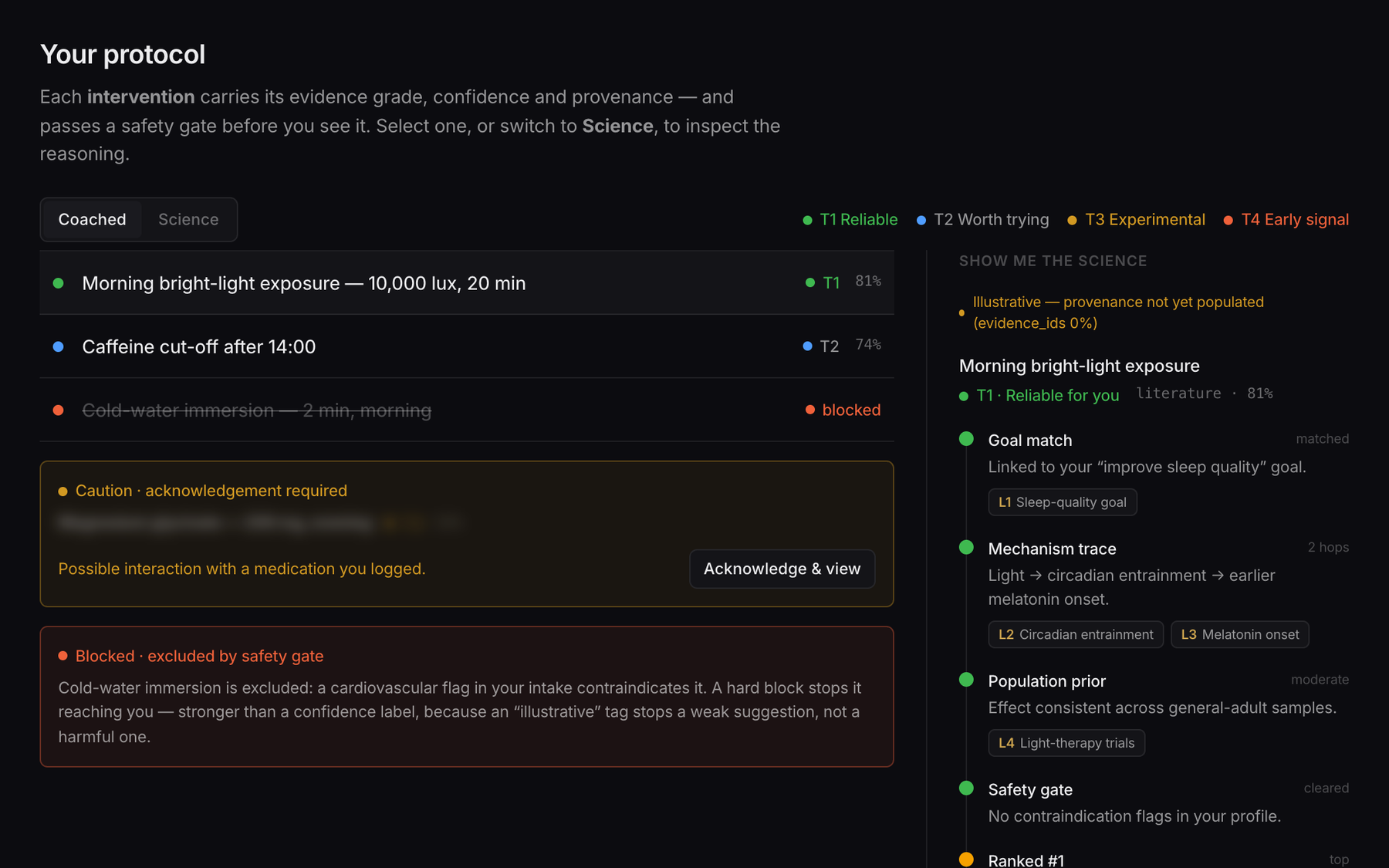
Daily protocol & NeuroNudges

A short, repeatable protocol with personalised NeuroNudges placed at your exact break points - making the next useful action easier rather than adding another system to maintain.

Daily protocol and NeuroNudges screen with science and safety gate context.
Step 06

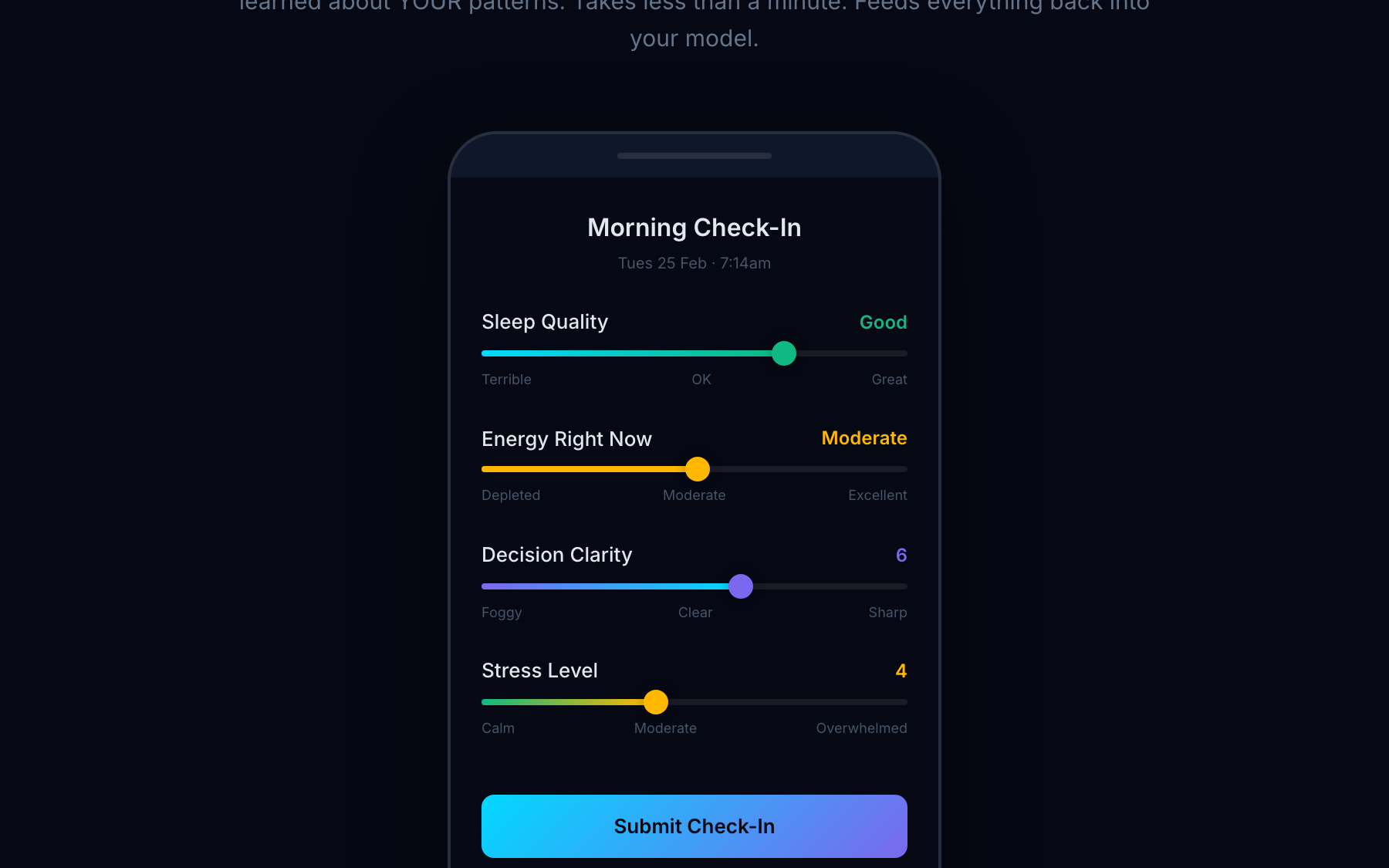
Daily Operating Loop

Each pass writes back what changed, what worked and what to surface next - so tomorrow never starts from zero and the loop becomes a flywheel.

Daily check-in screen after the check-in has been recorded.

The active layer most systems are missing

Understanding why you are stuck is not enough. The system has to help you move.

A NeuroNudge is a small, personalised change to the cue, context, sequence, environment, reward or first move around an action - selected to reduce the specific friction stopping that action from moving.

Forget generic habit hacks designed for an imaginary average brain. We locate the break, choose a plausible support, test it in real life and keep only what earns its place in your system.

A concrete programme deliverable

Your Personal NeuroNudge Library

Not a giant database of productivity tips. A small, usable collection of supports linked to your recurring break points, states and real response.

InitiationExample

The invisible first move

BreakThe task is meaningful but still feels too large or undefined to enter.
NeuroNudgeShow one 90-second first move plus a visible finish line for the first work block.
TrackTime-to-action, friction before/after and whether the task moved.
Re-entryExample

The thread disappeared

BreakAn interruption removes the context and restarting feels like rebuilding the whole job.
NeuroNudgeCapture the last decision, unresolved question and exact next move before switching.
TrackMinutes to re-enter and whether the correct version of the context was restored.
State matchExample

The plan assumed a different brain

BreakThe task requires more decision, memory or emotional capacity than is currently available.
NeuroNudgeRoute to a state-matched work menu or a lower-energy version of the same outcome.
TrackTask completion, cost, recovery and whether deferral would have been smarter.
Hyperfocus exitExample

The good focus that wrecks tomorrow

BreakUseful focus continues past the point where food, recovery, other commitments or closeout disappear.
NeuroNudgeTie an exit cue to an external event, save context and make the restart point explicit.
TrackExit success, downstream cost and quality of next-day re-entry.
NeuroNudges for Brain Battery

Make useful behaviour easier in the state you actually have.

  • Route lower-energy states toward work they can still run.
  • Protect high-value cognitive windows before they are spent on noise.
  • Reduce the setup cost of food, water, movement or recovery.
  • Create a low-energy version of an essential routine.
NeuroNudges for Problems + Goals

Make the next useful action more obvious and more available.

  • Replace “work on proposal” with one visible first move and proof of done.
  • Reduce choices when prioritisation is already overloaded.
  • Bring feedback or reward closer when the payoff is too distant.
  • Lower threat with a deliberately rough first pass or reversible decision.
NeuroNudges for the Daily Loop

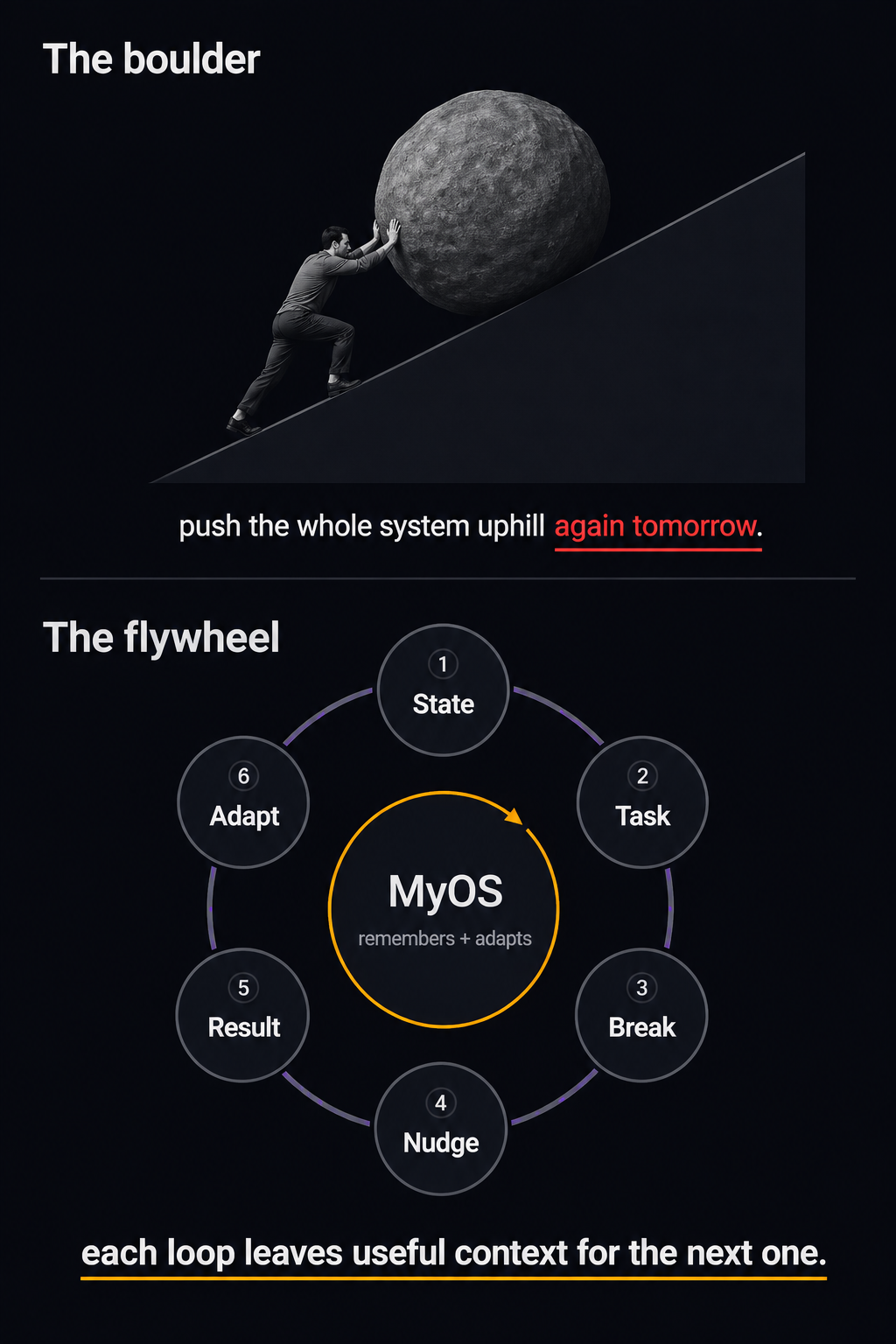
Stop the operating system becoming another boulder to push.

  • Save the exact next move before a context switch.
  • Use a one-click restart after a missed day instead of a backlog avalanche.
  • Pre-load known context so re-entry does not begin with reconstruction.
  • Close the day by writing back what changed, failed or needs surfacing.

Most habits and hacks are designed around generic, one-size-fits-all productivity advice. NeuroNudges are designed with you, around yours.

How a NeuroNudge gets selected
Step 1Locate the phaseWhere did the task stop moving?
Step 2Name the frictionAmbiguity, energy, context, reward, threat, memory, environment or something else?
Step 3Choose candidate leversReduce friction, change a default, add salience, move reward closer, restore context or simplify the first move.
Step 4Personalise the fitFilter by your current state, cognitive demands, environment, previous response and tolerable setup burden.
Step 5Test and adaptDid it reduce time-to-action, preserve context or improve re-entry without creating another maintenance job?

Behavioural science and relevant research provide candidate strategies. Your real-life response determines what remains in the system.

MyOS is the memory and adaptation layer

Turn the daily loop from a boulder into a flywheel.

A normal productivity system asks you to remember the system, update the system, interpret the system and restart the system - often using the exact functions that are already overloaded.

MyOS helps hold the state, task, break point, nudge and result outside your head. The point is not perfect tracking. The point is that tomorrow does not have to begin from zero.

  • Remember what you were trying to do and why.
  • Preserve the context that normally disappears.
  • Record which NeuroNudge helped in which state.
  • Surface a more useful next move instead of another generic reminder.
The boulder versus the flywheel: pushing the whole system uphill again tomorrow, versus a MyOS loop where each pass leaves useful context for the next.
A system that learns from the loop instead of demanding you rebuild it.The goal is low-friction memory, useful interpretation and easier re-entry.

Six weeks to a loop that survives Tuesday

Map it. Build it. Test it. Make it yours.

1:1 coaching with MyOS underneath. Each week produces something concrete you can use, test and carry forward.

Week 1

Map your Brain Battery

Baseline state, workload, routines, crashes, health inputs and the different kinds of cognitive output available across your real week.

Output: Brain Battery + State Map
Week 2

Map your Cognitive Architecture

Identify the recurring patterns across memory, context, salience, sequencing, initiation, switching, completion and recovery.

Output: Personal Cognitive Architecture + Friction Map
Week 3

Make work executable with TaskOS

Turn goals into state-matched tasks, visible next actions, clear done-states and easier re-entry points.

Output: TaskOS Lite Daily Execution Surface
Week 4

Build your NeuroNudge Library

Create and test personalised supports for your highest-cost break points across Brain Battery, goals and the daily loop.

Output: Personal NeuroNudge Library
Week 5

Test and tune the loop

Use MyOS check-ins and the proof/blocker log to see what moved, what created overhead and what should change.

Output: Adjustment Protocol + NeuroNudge Test Log
Week 6

Turn it into a flywheel

Harden the bad-day, missed-day, re-entry, closeout and continuation paths so the system survives real life.

Output: MyOS Blueprint + 30-Day Continuation Plan

What you actually leave with

Not just insight. A mapped and usable operating system.

Your maps

See the system you are currently trying to run blind.

  • Brain Battery + State Map
  • Personal Cognitive Architecture Map
  • Execution Failure-Mode Map
  • Audit of attempted fixes and problem mutations
Your active supports

Install support at the places where execution keeps dropping out.

  • Personal NeuroNudge Library
  • Point-of-action and re-entry supports
  • Bad-day, missed-day and restart paths
  • TaskOS Lite execution surface
Your learning loop

Remember what worked and adapt without starting again.

  • MyOS access and personalisation profile
  • Daily check-in rhythm
  • Proof/blocker + NeuroNudge test log
  • Adjustment protocol and continuation plan
You bring

Your real life, not an idealised week.

  • Your current routines, work patterns, crashes and attempted fixes
  • Any relevant wearable, sleep, food, training, health or work-context data you already have
  • One 65-minute call a week
  • Under a minute a day for low-friction check-ins
We build

A service-assisted system around your actual wiring.

  • We separate the visible problem from the hidden constraint
  • We design candidate NeuroNudges around the break point
  • We test what survives your real context
  • We simplify the loop until it is easier to re-enter than abandon
Jamie Lambe, founder of BodyCog
BSc Neuroscience Published research Behavioural science Physical AI Diagnosed ADHD

I built this for the brain I was wrecking

I kept solving parts of the problem - and being unable to see how they fit together.

I’m Jamie. I started BodyCog to combine mind and body coaching and now I’m taking what I've learned across over 50 clients to build MyOS. My background spans a degree in neuroscience, graduate neuroscience research on technology-enhanced learning, behavioural science consulting and years at one of the fastest-growing physical AI companies. I'm also a qualified Personal Trainer, Nutritionist and have a diploma in psychotherapy - for which I've written an independently published thesis on measuring psychological change across mind, body and behaviour.  But the qualifications that matter most here are less glamorous: late diagnosed ADHD, and years spent trying to understand how my brain worked and building systems that kept falling apart on me.

I tried everyting that ended up in the solutions graveyard: diagnosis, blood work, medication, supplements, routines, tracking, nutrition changes, training changes, coaching, productivity systems, second brains and more AI workflows than I care to admit.

The maddening part was not that nothing helped. It was that plenty helped - but only partially. Then I would lose the thread, misread the next crash or build another layer of a new system around the wrong constraint. When I actually dug into just how complex the problem is - before you think about managing it without a full time live-in doctor-therapist-PT-researcher - I realised that absolutely nothing accounted for all the failure modes I was experiencing. 

So I started building a system that could remember what changed, where execution broke and what support my brain actually needed.

That became MyOS, and the operating method inside this programme.
Founding cohort

Five founding places. £297, then £597.

Six weeks of 1:1 coaching, MyOS access, your Brain Battery and Cognitive Architecture maps, TaskOS Lite, a Personal NeuroNudge Library, your MyOS Blueprint and a continuation plan.

The honest reason the first five places are lower: I want serious people to run the full programme with real data and tell me what makes the system more useful. You get founder access and the lower price. I get a better signal about what to build before opening it wider.

Do the work, leave without a usable map and loop, and I refund you.

Show up to the calls, do the check-ins and engage with the build. If you leave without a clearer map of where execution breaks, a usable daily operating loop and a practical continuation plan, I’ll refund you.

The objections already forming in your head

Questions worth answering before you book.

“I’ve tried everything already.”

You have probably tried a lot of useful things. The question is whether each one was aimed at the right constraint, tested in the state and context where you actually need it, and integrated into a loop you could re-enter later. This programme is designed to map that difference.

How is this different from ADHD coaching?

ADHD coaching can be useful. This programme is built around a more explicit operating architecture: Brain Battery, an 11-phase TaskOS execution map, personalised NeuroNudges, MyOS memory and a proof/blocker loop. Coaching is how we interpret and install the system around your context.

What exactly is a NeuroNudge?

A NeuroNudge is a small change to the cue, context, sequence, environment, reward or first move around an action. We choose it for a specific break point, test whether it reduces friction and remove it if it creates more maintenance than value.

Does MyOS automatically read my brain state and tell me what to do?

No. This founding programme is service-assisted, not a proven autonomous brain-reading product. We use your check-ins, context, existing data and observed patterns to build and adapt the loop with you. More of this may become self-serve over time, but that is not the current promise.

Do I need wearables, blood work or genetic data?

No. Bring any relevant information you already have, but the programme does not require expensive testing and does not use one biomarker or genetic result as a universal explanation. Your lived pattern, current state, task demands and response to the loop remain central.

Is this medical advice or ADHD treatment?

No. It is coaching plus a self-audit and operating-support system. It does not diagnose, treat, cure or replace clinical care. Medication, therapy and clinical support can be important; this sits alongside them as practical operating support.

How much time does it take?

One 65-minute session each week, plus low-friction daily check-ins designed to take under a minute. There may be small experiments or setup actions between calls, but the programme is specifically designed to avoid becoming another full-time system-maintenance project.

Stop solving the wrong problem

Find where your chain keeps snapping - and build support around the actual break.

Book the free Brain Battery call. We’ll look at what keeps frying your brain, what you have already thrown at it and whether this is the right build for you.